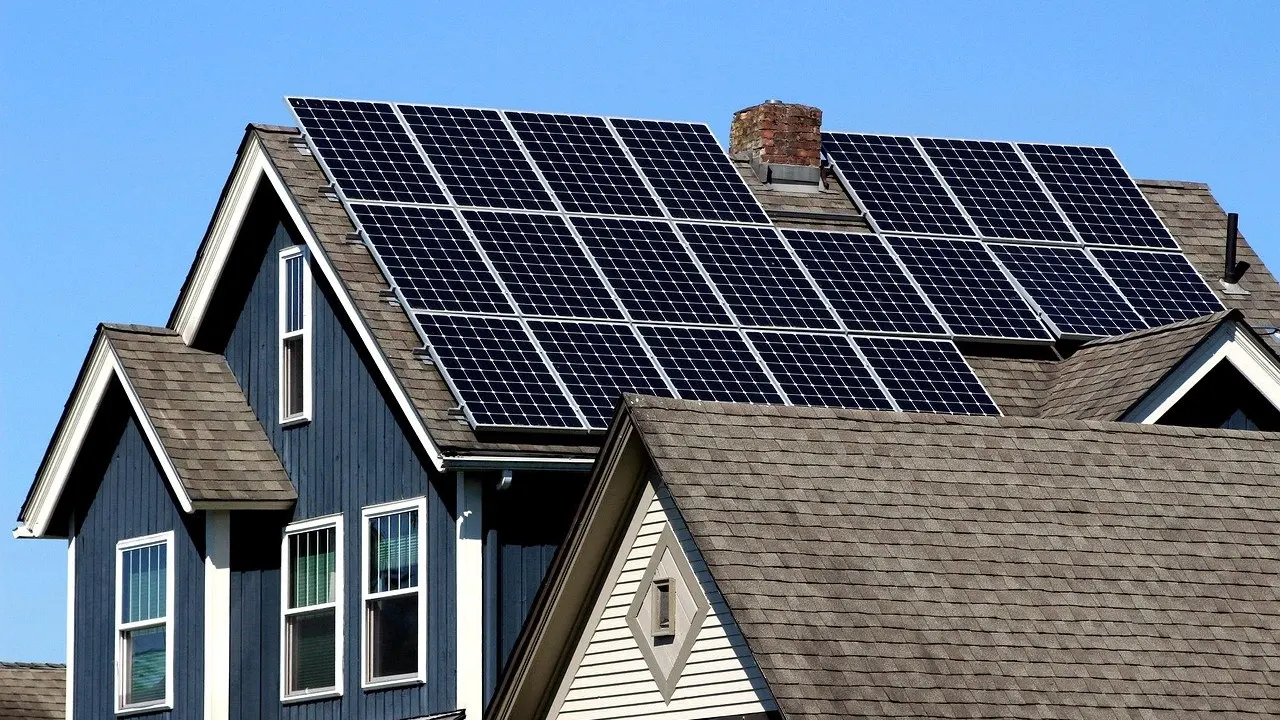
The pros and cons of solar panels for home use balance a sizeable upfront cost against lower bills over a long system life. Roof shading and local credit rules decide whether the numbers work.
This guide sits within our wider coverage of renewable energy. It explains how the savings arise, what a system costs, which incentives apply and where the limits are, so you can judge a quote with confidence.
How home solar earns its savings
A rooftop system saves money only to the extent that it produces power when your house can use it or when your utility credits it. Three stages explain how that plays out.
- Panels produce only in daylight. Installer guidance notes that solar panels only operate when it is at least somewhat sunny, so output follows the weather and the hours of light, not your evening demand.
- The grid fills the gaps. Grid-tied solar panels maintain a grid connection so you always have access to power when the sun is not shining. Most households can therefore run solar without giving up the electricity grid.
- Local policy sets the value of surplus. What your spare daytime output is worth depends on the credit scheme where you live, which is covered under incentives below.
The practical consequence is that two identical systems can deliver very different savings, depending on shade, weather and the credit rules behind them. For the equipment side of the story, see How Solar Panels Power Your Home: A Clear Guide For Homeowners (2026) – Fixourfuel. Next, the money.
What home solar costs and how long it takes to pay back
Cost is the first question most buyers ask, and the pack supports two reference points: a current-style installed range for Alberta and a dated per-watt average. Neither is a quote, so use them to sanity-check bids rather than to budget a project.
| Figure | Value and condition | Planning use |
|---|---|---|
| Typical installed system cost, Alberta | Approximately $10,000 to $16,000, before rebates (currency as stated, year not given) | A ballpark for comparing early quotes; rebates then reduce the net figure. |
| Payback after installation | About 8 years (US vendor estimate) | An illustration of the order of magnitude, not a forecast for your roof. |
| Financial horizon of the system | Financials secured over a 25+ year lifetime (installer claim) | Shows that the payback period sits well inside the intended service life. |
The cost and horizon figures come from an Alberta installer’s guide, and the payback estimate comes from a US solar provider’s overview.
Per-watt pricing
Quotes are often compared per watt of capacity. A residential solar guide reports that in 2018 homeowners were paying between $2.71 and $3.57 per watt to install solar. Treat that as a historical marker: the same source says solar costs have since fallen, so a current bid should be judged against fresh local quotes, not against 2018 averages.
Reading the payback figure
The payback estimate of about 8 years is a vendor’s statement for a US system. Your own result depends on how much electricity you use, what incentives you receive, how much shade your roof gets and how your utility credits exports. Compare it with the typical panel life of around 25 to 30 years on average, as the same US provider states: a payback well inside that span leaves years of production once the system has covered its cost, whereas a long payback on a shaded roof leaves much less margin.

Incentives, net metering and feed-in tariffs
Incentives change the cost side of the equation, while credit schemes change the savings side. Both vary by location, so check the rules that apply to your address before comparing quotes.
Tax credits and rebates
In the United States, one installer states that solar panels and battery storage systems qualify for a 30% federal tax credit, a statement dated 2024. Another guide says you could claim up to 30% of your total installation costs, depending on location. Read these as a ceiling that depends on your circumstances, not a guaranteed discount, and confirm eligibility with a tax adviser or the programme administrator before relying on it. Because the credit is described as covering battery storage too, it matters if you plan to add home batteries to the system.
In Canada, the picture is provincial. Alberta installer guidance says government incentives are already playing a major role in reducing the investment required, though it gives no amount, so ask each installer to show the rebate as a separate line on the quote.
Net metering and feed-in tariffs
Net metering lets exported solar energy offset what you draw from the grid, and its availability is local. A US provider notes that, depending on the state you live in, you have the option of net metering. A residential solar guide reports that all utilities in Ohio must offer net metering, which shows how much the rule can differ from one state to the next.
A feed-in tariff pays a set price for the power you generate. Ontario’s programme is the Canadian example: Ontario’s Feed-in-Tariff program developed a fledgling industry into Canada’s leading solar province. No current tariff rate is given in the pack, so confirm with your utility whether a tariff, net metering or another credit is on offer before you count on any specific income from exports.
Advantages of home solar
The case for solar rests on a few well-supported strengths, and they work best together.
- Falling prices. The residential guide cited above says the solar cost has dropped by almost 70 percent over the decade it examines. Lower prices are the main reason payback now looks more reachable than it once did.
- Credit for surplus. Where credits exist, the retailer tracks imports and exports. Alberta installer guidance describes retailers monitoring how much solar energy you import versus export and crediting you accordingly, so daytime surplus offsets purchases from the grid.
- Less strain on the grid. A US solar provider says solar can lessen the strain on the electrical grid. This is a public benefit rather than a personal saving, so weigh it as a bonus, not as part of your payback.
- Incentive support. Credits and rebates, where available, shrink the net outlay, as described above.
Drawbacks and limits
The downsides are mostly about fit: the wrong roof or the wrong policy environment weakens the whole case.
- Shading. Nearby obstructions can reduce the amount of sunlight your panels receive, and another installer advises that your roof also needs to be free of significant shading for optimal sunlight access. If a tree or neighbouring structure shades the roof for much of the day, get that assessed before signing.
- Weather dependence. Output follows the sun, as the stages above explain, so cloudy periods reduce production and you keep buying from the grid.
- Upfront outlay. The installed range in the table is the largest hurdle for most households, and the net figure depends on rebates that vary by region.
- Policy dependence. Net metering is state-specific in the US and credit schemes differ across Canadian provinces, so a savings estimate is only as reliable as the local rules behind it.
None of these limits is a reason to dismiss solar, but each is a reason to check specifics at your address before committing.
Is solar worth it for your home?
Solar is most likely worth it when your roof is clear of shade, a credit scheme values your exports and you can wait out the payback period. It is a weaker proposition when shading is heavy or the local credit rules are unclear. Work through these steps in order:
- Assess shading first. A shaded roof undermines every other number, so settle this before collecting quotes.
- Understand your electricity use. An energy check of the house helps you size a system sensibly; our guide to Home Energy Audit Cost: What To Expect To Pay And How To Save In 2026 – Fixourfuel covers what that costs.
- Identify your local credit scheme. Ask your utility whether net metering, net billing or a feed-in tariff applies, because that decides what surplus power earns.
- Request itemised quotes. Make each installer show the system price, the rebate or tax credit and the expected payback separately, so you can compare like with like against the ranges above.
- Decide on batteries separately. Treat storage as its own purchase, since it is a distinct cost, even where an incentive covers it.
The balanced verdict: solar is a long-horizon investment that rewards good roofs and supportive local policy, and it disappoints where shade or rule changes erode savings. Judge it on your own quotes and local rules, not on a headline payback figure.
Frequently asked questions
Can solar panels power my home during an outage?
Not by themselves in every case. Installer guidance says solar batteries can supply backup power during an outage, so a battery is the component to ask about if outage cover matters to you.
Is net billing the same as net metering?
They are similar credit ideas under different names and rules. In Alberta and other Canadian provinces, net billing means the retailer monitors how much solar energy you import versus export and credits you accordingly. US net metering depends on the state, so ask your utility which applies.
How long do solar panels last?
A US solar provider puts typical panel life at around 25 to 30 years, on average. Check each manufacturer’s warranty terms for the specific equipment you are quoted.