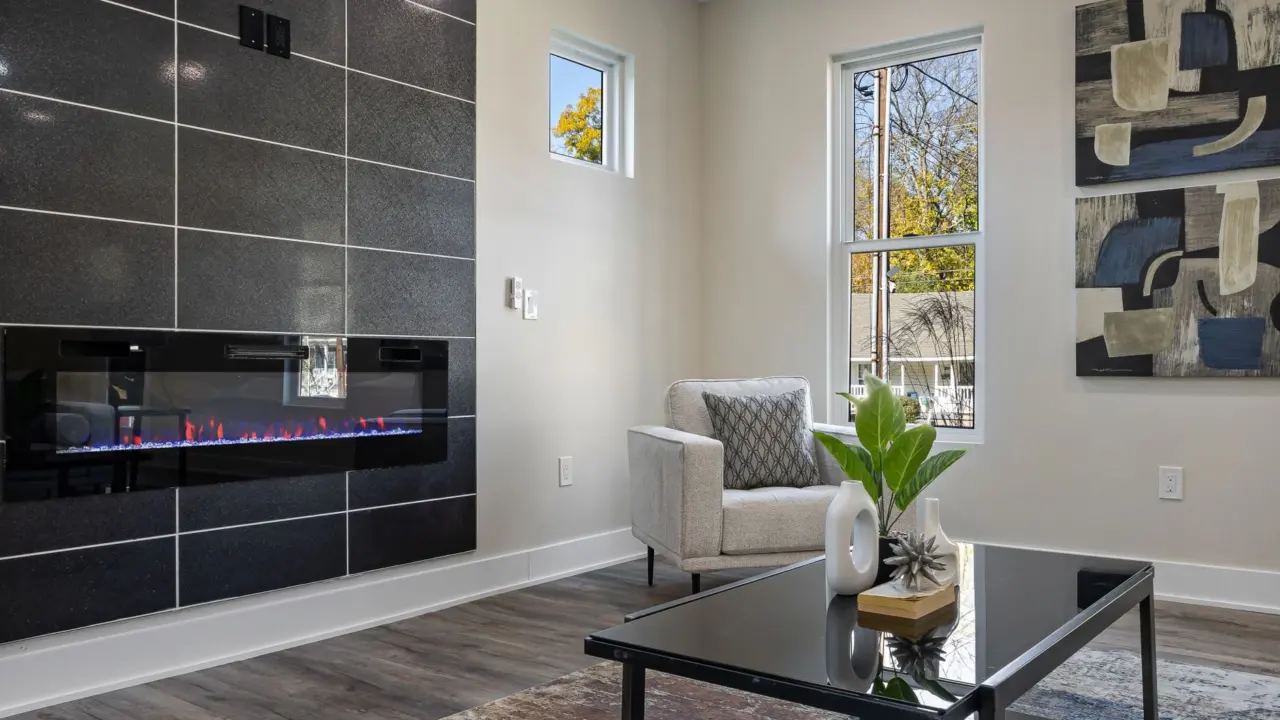
Wondering how much electricity does an electric fireplace use before you switch it on? The heater is the big load, typically about 1.4 kW to 1.6 kW, while the flame display alone draws roughly 10 to 20 W.
Your running cost depends on which mode you choose and on the price per kilowatt-hour (kWh) on your own bill, so this guide works from a formula you can reuse. For the wider picture on how households use and source power, see our guides on renewable energy.
Flame-only mode versus heater mode
A common misunderstanding is that the glowing flame is what costs money. It is not. Flame-only mode draws roughly 10 to 20 W, so the heater is the load worth budgeting for. Heat output varies between models but is typically around 1.4 kW to 1.6 kW. Thermostat cycling, selected output, display mode and operating time all change consumption, so two identical units can cost very different amounts depending on how they are used.
| Mode | Power draw | Running example | Planning use |
|---|---|---|---|
| Flame-only | Roughly 10 to 20 W | 3.6 kWh over 30 days at 8 hours a day, about 66 cents at 18.44 cents/kWh | Cheap enough to run for ambience; it is not the figure to budget around. |
| Heater on high | 1,500 W, or 1.5 kWh for each hour of constant operation | 180 kWh and $32.96 over 30 days at 4 hours a day and $0.1831/kWh | The figure to budget when warmth is the goal. |
| Heater on a lower setting | 750 W on plug-in models with two settings | Apply the cost formula below with your own rate | Check whether your model offers it before assuming high is the only option. |
The flame-only and plug-in setting figures come from a published comparison of flame-only and heater use, and the high-heat monthly example from an illustrative 1,500 W cost table.
For ambience without warmth, flame-only mode is the sensible choice. Its draw is small enough that the heater setting, not the display, should drive any decision about how long to run the unit. When you do want warmth, track the heater against your rate, as the cost section below shows.
What the wattage label really tells you
The second misunderstanding is that one wattage figure fits every electric fireplace. The watts on the label or in the manual are the better guide for your own unit.
- “Every model draws the same.” There is no universal heater or flame-only wattage for every electric fireplace, so check the documented draw for your model. Across top-selling electric fireplaces, the average is 1,444 W and the most common is 1,500 W. Treat those as a sense of scale, not a substitute for your label.
- “Plug-in units offer fine control.” Nearly every plug-in model has two settings, 750 W and 1,500 W, plus flame-only. Choosing the lower setting when the high one is not needed is the simplest way to reduce hourly draw.
- “The rated wattage is what it draws all the time.” The rating is the draw while the heater element is on. Thermostat cycling can reduce heater run time, so average use over an evening can sit below the rating. A cost estimate based on constant full output therefore works as a ceiling for that pattern of use, not a forecast.
Once you know the documented wattage for your unit, turning it into money takes one formula and your electricity rate.
Cost per hour and per month at your own rate
The calculation is cost = watts ÷ 1,000 × hours × price per kWh. Take the wattage from your label, choose the hours you realistically run the unit, and use the price per kWh printed on your own bill. Because the rate is the variable that moves most from household to household, substitute your own instead of memorising anyone else’s total.
Two published examples show how the formula behaves at different rates:
- Per hour at $0.1831/kWh. Illustrative constant 1,500 W operation uses 1.5 kWh and costs $0.27. Run for 4 hours a day over 30 days, that comes to 180 kWh and $32.96.
- An evening at $0.22/kWh. A worked example multiplies 1.5 kW × 3 hours × $0.22/kWh = 99 cents for the evening.
The same wattage costs more at the higher rate and less at a lower one, which is why a monthly total quoted for someone else’s tariff is only a rough guide. The monthly figure above assumes the heater runs constantly. If your fireplace has a thermostat and the room reaches temperature, your real bill should come in under it. Flame-only evenings add little by comparison, so the heating hours are where to focus when you tally the month.
Electric fireplace versus space heater and central heating
Electric resistance heat is 100 percent efficient at the point of use. Efficiency at the point of use is therefore not what separates one electric heater from another. The cost formula treats a space heater and a fireplace heater identically: only the watts, the hours and your price per kWh matter. A fireplace suits people who want the flame effect as well as warmth.
Whether an electric fireplace is cheaper than central heating has no single answer. It depends on local energy prices, the actual appliances, operating time and the useful heat delivered. A fireplace is most likely to make sense as zone heating, where you warm the room you are using and let the rest of the house run cooler. That is why the advice is to turn the central thermostat down when the fireplace is on. If you would otherwise heat unused rooms, the fireplace has the stronger case. If you leave it running for long stretches to warm a large open area, compare it carefully against your furnace on a like-for-like cost per unit of heat.
If you are weighing the wider question of how your home is heated, our guide to Cleaner Energy Alternatives To Fossil Fuels: Practical Options For 2026 – Fixourfuel covers the options beyond electric room heating. The same watts-hours-rate arithmetic applies to other appliances too, as in How Much Electricity Does a Fan Use? Real Costs, Examples, And Savings In 2026 – Fixourfuel.
Ways to lower running costs
Savings come from running the heater less, not from the flame display. These habits do that without giving up the fireplace.
- Let the thermostat do the work. Thermostat cycling can reduce heater run time. Set the target to the temperature you find comfortable rather than the highest it allows.
- Lower the central thermostat while it runs. Heating the same room twice is the clearest waste, so turn the central thermostat down when the fireplace is on.
- Choose a model with a shutoff timer. A timer, like the 8-hour setting on one wall-mount unit, stops you heating an empty room.
- Match the setting to the need. Selected output and display mode change consumption, so use the lower heat setting or flame-only mode when the room is already comfortable.
- Check the documented draw before buying. Because wattage is model-specific, compare labels instead of assuming a typical figure applies.
Frequently asked questions
| Question | Answer |
|---|---|
| Does a higher Btu figure mean a better or cheaper fireplace? | No. Btu is a conversion of watts: 1 W is approx. 3.412142 Btu/h, so 1,500 W is roughly 5,118 BTU per hour. A high Btu number does not guarantee effective room heating, because performance depends on air movement, and it says nothing about your bill. |
| What range of hourly cost should I expect? | A UK-based example prices a 1.4 kW heater at 29p/kWh at 40p an hour. A study-based range for household units of 1 kWh to 1.5 kWh per hour works out to US $0.15 to $0.23 per hour. Your own rate moves these figures up or down. |
| How much power does the flame effect itself use? | The LED lights inside an electric fireplace might have a combined rating of as little as 10 W, and even in larger fires the total is likely to be under 30 W. |